What Happens If You Delay Basement Flood Cleanup?
What Happens if You Delay Basement Flood Cleanup?
Delay turns a water damage problem into several other problems. Moisture migrates deeper into materials, mold risk rises past the 24 to 48 hour window EPA references, porous materials move from "could be dried" to "has to come out," structural damage can begin, and the eventual cleanup scope expands into mold remediation territory that is a different and costlier specialty. The water you can see at hour one is a smaller job than the moisture in the walls at hour seventy-two.
The common thinking is that water in a basement can "just dry on its own" if a dehumidifier is running. That is partly true for surface moisture in favorable conditions. It is not true for saturated drywall, carpet padding, insulation, subfloor and the back of finished assemblies. Those materials release moisture slowly even under ideal conditions, and when they do not get help, the moisture stays long enough to cause the secondary problems below.
What Happens at Each Stage of Delayed Basement Cleanup?
| Time after flood | What is likely happening | What becomes harder |
|---|---|---|
| 0 to 1 hour | Water sitting on surfaces, running into porous materials | Quickest window for simple extraction |
| 1 to 6 hours | Carpet padding saturated, water wicking up drywall | Carpet padding usually unsalvageable past this point |
| 6 to 24 hours | Water migrating into wall cavities, insulation absorbing | Hidden materials harder to dry in place |
| 24 to 48 hours | EPA mold-risk window: wet structure treated as at risk for mold | Mold-prevention threshold crossed |
| 2 to 7 days | Mold growth may be establishing on organic surfaces; odor often developing | Material removal scope often grows significantly |
| 1 to 4 weeks | Visible mold possible; structural staining; softened subfloor; corrosion on metal | Often requires specialized remediation rather than standard cleanup |
| Beyond a month | Established mold, damaged assemblies, possible pest activity, deteriorating air quality | Scope resembles reconstruction more than cleanup |
These are typical patterns under moderate conditions. Warmer, wetter conditions accelerate the timeline; colder, drier conditions slow it. The 24 to 48 hour EPA window remains the professionally-referenced threshold either way.
What Specific Problems Come From Delayed Basement Cleanup?
- Mold growth. Addressed in detail in our mold timeline guide. Mold remediation is a specialized scope, usually more expensive than standard water damage cleanup.
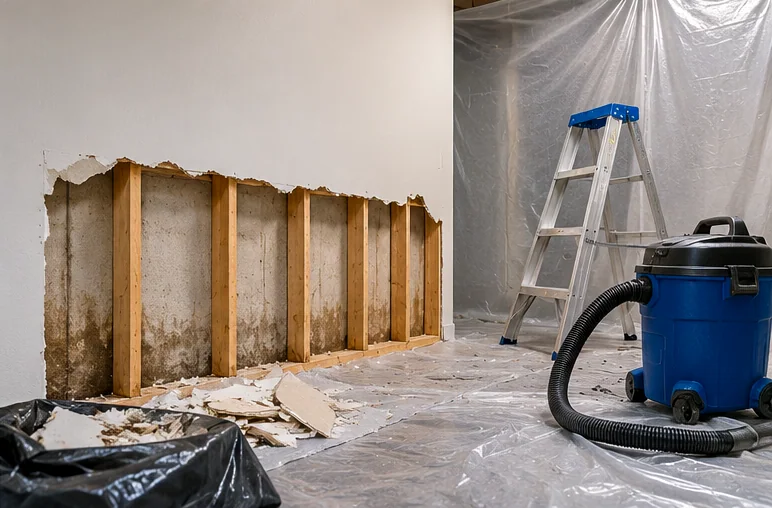
- Material loss. Materials that could have been dried in place become removal candidates. A wall section that might have been saved at hour six often cannot be saved at hour seventy-two.
- Structural damage. Wet subfloor loses strength. Wet framing can warp. Wet masonry can show new cracks under temperature change.
- Odor. Musty odors from biological activity and bacteria. Odor that persists past cleanup is usually a sign of continued moisture or contamination at the source.
- Indoor air quality. Spores and VOCs from biological activity affect the air in the rest of the home, especially where basements share return air with the HVAC system.
- Insurance complications. Many policies require prompt mitigation to prevent further damage. Significant delay can result in coverage disputes over secondary damage.
- Contents loss. Belongings that might have been salvaged with quick action are lost as moisture settles and mold develops on cardboard, fabric and wood.
- Health effects. Mold and contaminated water can affect occupants, especially those with asthma, allergies or immune conditions.
Will Basement Water Go Away on Its Own?
Surface water on bare concrete in a warm, dry, well-ventilated basement will eventually evaporate. That is where the comfort of "it will dry on its own" comes from. The problem is everything else.
Water that has been absorbed into porous materials (drywall, insulation, carpet padding, subfloor) stays in those materials for days or weeks without help. Water that has migrated into wall cavities or beneath flooring has essentially no pathway out on its own. Moisture settling into stored belongings does not evaporate before the belongings are damaged.
Even a small, clean-water puddle that "disappears" leaves behind contamination, mineral deposits, and dampness in the slab and any adjacent material. If the basement is finished, if the water category is anything beyond Category 1 clean water, or if the event was more than a small amount, waiting it out is not a strategy.
What if You Have Already Delayed Basement Flood Cleanup?
If the window has already passed, the response is the same sequence but with a wider initial assessment. Do not panic, and do not try to speed through cleanup to catch up. The structure now needs:
1. A more thorough inspection.
Moisture readings on everything that could be wet, plus a check for visible mold indicators, odor sources and structural signs. See our moisture inspection service.
2. Honest expectation setting.
Material removal scope will likely be wider than it would have been at hour six. Carpet padding, more wall section, more insulation.
3. Separate mold scope if indicated.
If growth is found, mold remediation runs on its own scope before or alongside the water damage work, with the right sequencing.
4. Drying with readings.
Same as a timely response but likely longer, because moisture has penetrated further.
5. Reconstruction after verified dry.
Same rule as always: nothing closes back up until readings confirm a dry structure.
Insurance reporting also becomes more time-sensitive at this point. Notify the insurer promptly, be honest about the timeline, and keep every piece of documentation. The call from the adjuster is easier when the scope is well-documented even if the start was late.
Frequently Asked Questions
Will the water in my basement just go away on its own?
Surface water on bare concrete in warm dry conditions can eventually evaporate. Water absorbed into porous materials or inside wall cavities does not go away on its own in any useful timeframe. Waiting it out leads to mold, material loss, structural damage and insurance complications.
What happens if I wait 48 hours to clean up a flooded basement?
EPA treats a wet structure past about 24 to 48 hours as at risk for mold growth. Materials have usually absorbed moisture deeper by then, mold has time to begin establishing on organic materials, and the cleanup scope typically expands beyond what it would have been at hour six.
Can delay affect my insurance claim?
Yes. Many policies require prompt mitigation to prevent further damage, and significant delay can result in disputes over coverage for secondary damage (mold, worsened material loss) that could have been prevented with faster response. Document the timeline honestly either way.
What does delayed basement water damage do to the structure?
Wet subfloor loses strength, wet framing can warp, wet masonry can show new cracks, wet drywall deteriorates and stops holding finishes. Prolonged moisture also supports mold, pest activity and corrosion on metal. Secondary damage often exceeds the original flood damage if delay is long enough.
Is it too late to clean up a basement that flooded a week ago?
No, but the scope is wider. The response starts with a more thorough inspection including moisture readings and mold indicators. Material removal is usually more extensive than it would have been at hour six, and if mold is present it runs as a separate specialized scope. Full cleanup is still achievable.
Can running a dehumidifier alone recover a delayed basement flood?
Dehumidification helps, but it cannot by itself drive moisture out of saturated materials inside wall cavities or beneath flooring, and it cannot reverse mold that has already established. It is part of recovery, not a substitute for professional assessment when the delay has been significant.