How Fast Can Mold Grow After a Basement Flood?
How Quickly Can Mold Grow After Basement Flooding?
Mold can begin to develop when damp conditions persist on susceptible materials, and the EPA recommends cleaning and drying wet materials within about 24 to 48 hours where possible to limit mold growth. Past that window, EPA treats a wet structure as at risk for mold contamination.
That window is a risk threshold, not a guarantee. Mold does not follow an exact universal clock. Spores are present in nearly all indoor air; what they need to establish visible growth is enough moisture, a food source, enough time, and compatible temperature. A basement after a flood provides three of those four in abundance, and the fourth is what the 24 to 48 hour timeline manages.
What matters most for homeowners is this: visible surface dryness does not clear the mold risk. A dry-looking wall with saturated drywall backing or wet insulation inside is exactly the condition where mold establishes out of sight and surfaces as a smell or a stain weeks later.
What Conditions Cause Mold to Grow in a Flooded Basement?
| Factor | Role in mold growth | What affects it in a basement |
|---|---|---|
| Moisture | Mold needs a damp environment on or in the material | Standing water, high humidity, wet building materials |
| Food source | Mold feeds on organic material | Paper facing on drywall, wood, cellulose insulation, dust, carpet backing |
| Temperature | Most indoor molds prefer moderate temperatures | Typical basement temperatures are within the preferred range |
| Time | Spores need time to germinate and establish | EPA references 24 to 48 hours as a risk threshold |
| Air movement | Stagnant moist air favors growth | Closed basements with poor ventilation hold humidity |
Remove any one of these and you slow or stop growth. The main lever a homeowner controls after a flood is moisture: drying wet materials quickly and keeping humidity low. The 24 to 48 hour window exists because once materials have stayed wet beyond it, moisture has often penetrated deep enough that surface drying no longer clears the condition.
Which Basement Materials Are Most Prone to Mold Growth?
Not every wet material is equally at risk. The key is whether the material is porous, whether it contains organic content, and whether moisture can be removed before biological activity establishes.
- Paper-faced drywall. Paper facing is organic and holds moisture. High risk once saturated for more than a day or two.
- Fibrous insulation. Fiberglass and cellulose hold water inside wall cavities where airflow cannot reach. Often removed after flooding.
- Carpet padding. Dense, absorbent, hidden under the carpet. Classic mold host.
- Wood framing and subfloor. Can harbor mold where saturated, especially where moisture is trapped by adjacent finishes.
- Cardboard, paper, fabric contents. Rapid absorption, limited recovery after sewage or extended exposure.
- Dust and settled debris. Ordinary surface dust contains enough organic material for mold if the substrate stays wet.
- Concrete. Not itself a food source, but surface dust and dampness together can support limited growth. Concrete also keeps materials above it damp.
- Nonporous surfaces. Sealed metal, glass, finished hardwood. Lower risk if cleaned promptly.
How Do You Prevent Mold After a Basement Flood?
The goal is to get materials dry before mold has time to establish, and to remove materials that cannot be reliably dried. The sequence that works:
1. Remove standing water fast.
Every hour of standing water increases how deep moisture penetrates into materials.
2. Remove materials that cannot be dried.
Saturated carpet padding, wet insulation and severely wet drywall sections come out. Trying to dry them in place usually fails.
3. Open assemblies for airflow.
Remove baseboards and drill small ventilation holes where needed so air can reach the back of walls. Open cabinet doors and move stored items away from walls.
4. Run air movers and dehumidifiers continuously.
Switching off overnight undoes part of the day. Humidity creeps back up and materials stop releasing moisture.
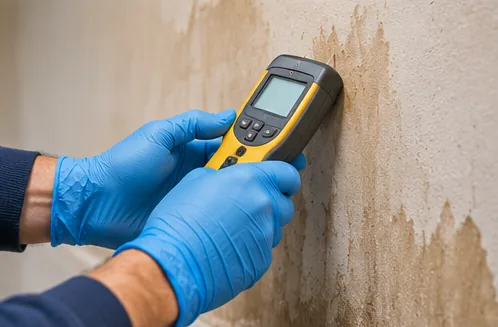
5. Verify drying with readings.
Moisture meters on affected materials, compared to reference readings in unaffected areas. Appearance is not evidence.
6. Clean surfaces before closing anything back up.
Surface cleaning handles any spores that have settled. Sanitizing where the water category warrants it.
This is why the structural drying service matters so much after a flood. Appearance-based drying misses exactly the conditions mold prefers.
What Should You Do if Mold Has Already Started in a Flooded Basement?
Visible mold is a sign the moisture has been present long enough for growth to establish. The response is different from ordinary drying.
- Do not disturb large growth without controls. Breaking up established mold releases spores. Small areas on a nonporous surface can be cleaned carefully; larger areas or porous substrates are a specialist assessment.
- Wear appropriate PPE. At minimum, an N95 or better, gloves and eye protection for anyone near affected areas.
- Keep the area isolated. Close doors, turn off HVAC that would spread air through the space, and keep people out.
- Get an assessment. Scope the extent before planning the response. EPA publishes homeowner mold remediation guidance for reference.
MH Restoration does not perform standalone mold remediation as a service category. If an active mold situation is found, we scope the basement water damage work and refer the mold scope to a qualified specialist, and we coordinate the sequence so one does not undo the other.
What are the Signs of Mold Growing in a Basement?
- Musty, earthy odor that returns when the space is closed up.
- Visible discoloration on walls, ceilings or floors, especially in corners, behind furniture, under paint.
- Staining or spotting that appears or spreads over days or weeks.
- Peeling paint, bubbling finish, or warped drywall surfaces.
- Darkening of caulk, grout or sealants in the basement.
- Allergic-type symptoms in occupants that improve when away from the space.
Not every musty smell is mold, and not every stain is growth. But any of these after a flood warrants an inspection rather than painting over it.
Frequently Asked Questions
How fast can mold grow after basement flooding?
EPA recommends cleaning and drying wet materials within about 24 to 48 hours where possible to limit mold growth. Past that window, a wet structure should be treated as at risk for mold. Mold does not follow an exact universal clock; actual growth depends on moisture, material, temperature and time.
Will my basement grow mold if I dry it within 48 hours?
In most cases drying affected materials fully within that window is enough to prevent visible growth. The risk rises past 48 hours because moisture has often penetrated deeper than surface drying reaches, and spores have had more time to establish.
Can mold grow behind basement walls after flooding?
Yes, and it is the most common mold source after a flood. Wet drywall backing, wet insulation and wet framing inside wall cavities can support growth that is invisible from the room side. Moisture meter readings at the right depth are the honest check.
Does dehumidifying a basement prevent mold after a flood?
It helps if it runs continuously and the basement has enough air movement to pull moisture out of materials. Dehumidification alone, without air movers and without checking readings, often misses moisture deep in materials where mold actually starts.
What does mold look like in a flooded basement?
Often a musty odor comes first, followed by visible discoloration on walls, ceilings, corners, behind furniture or along baseboards. Dark spots, fuzzy growth, or spreading stains all qualify. Peeling or bubbling paint over damp substrate is another indicator.
Is there a dedicated mold remediation service at MH Restoration?
MH Restoration does not offer standalone mold remediation as a service category. When mold is found during basement water damage work, we scope the water damage and coordinate the mold scope with a qualified specialist so the sequence is correct and one job does not undo the other.