
How to Remove Water From a Basement: Methods and Safety
What is the Best Way to Remove Water from a Basement?
The best way to remove water from a basement is not a single method. It is the method that matches the water depth, the water category, the electrical safety of the room, and whether water is still coming in. A wet vacuum, a utility pump and professional truck-mounted extraction all have a place, and the wrong choice for the situation either wastes time or creates safety problems.
Shallow clean water on accessible concrete is one problem. Three inches of storm runoff with saturated soil outside the walls is another. The first is often a wet vacuum job after an electrical safety check. The second is a controlled pump-down that qualified people manage carefully, because draining a deeply flooded basement too fast while surrounding soil is still saturated can create damaging pressure differences against the walls and floor, a risk documented by both the University of Missouri and University of Nebraska extension services.
How Much Water is Really in a Flooded Basement?
Most homeowners underestimate the volume. Here is the math for a common scenario: a 500 square foot basement with 3 inches of standing water holds about 935 US gallons. A 1,000 square foot basement at the same depth holds about 1,870 gallons. For roof-runoff context, the University of Minnesota Extension notes that a one-inch rain on a 2,000 square foot roof produces roughly 1,250 gallons of water, which concentrates near the foundation if downspouts discharge there.
| Basement area | 1 inch of water | 3 inches | 6 inches |
|---|---|---|---|
| 400 sq ft | ~249 gal | ~748 gal | ~1,496 gal |
| 600 sq ft | ~374 gal | ~1,122 gal | ~2,244 gal |
| 1,000 sq ft | ~623 gal | ~1,870 gal | ~3,740 gal |
| 1,500 sq ft | ~935 gal | ~2,805 gal | ~5,610 gal |
Illustrative calculations at 7.4805 US gallons per cubic foot. Not a measurement of a particular property.
Household shop vacuums hold maybe five to sixteen gallons. The math alone tells you that a shop vac empties the floor only in the smallest cases.
How Do You Choose the Right Water Removal Method?
Choice depends on four variables: depth, category, electrical safety and whether water is still entering.
| Situation | Appropriate method | Why |
|---|---|---|
| Small puddle, clean, hard floor, caught quickly | Wet vacuum after electrical safety check | Simple, contained, low risk |
| 1-3 inches, clean, large area | Submersible utility pump or extractor | Volume exceeds practical wet-vac capacity |
| Deep water, saturated soil outside | Controlled, staged pump-down by qualified crew | Fast draining can damage walls from pressure differential |
| Water touching outlets or panel | No removal until power isolated by electrician/utility | Electrocution risk |
| Sewage or contaminated water | Professional contaminated-water extraction | Containment, PPE, disposal requirements differ |
| Water still coming in | Control source first or extract concurrently with source fix | Extracting against active inflow is wasted effort |
| Residual moisture after visible water is gone | Air movers + dehumidifier, not more vacuuming | Material moisture requires evaporation, not suction |
Why Rapid Pumping Can Damage a Deeply Flooded Basement
This is the point that generic cleanup articles skip. In a shallow or indoor-source flood, pumping fast is fine. In a deep flood where groundwater or external flooding has saturated the soil around the foundation, the water inside the basement is actually helping to balance the water pressure outside. Draining the inside too quickly can leave the exterior pressure unopposed, which stresses foundation walls and floor slabs that may already be weakened.
The guidance from University of Missouri Extension and University of Nebraska Extension is to pump the water level down gradually when surrounding soil is saturated, monitoring for cracks, bowing or new water entry. This is one of the clearest cases where "fast" is actually worse than "controlled."
In practice, after a major external flood, pump the water down until about two to three feet remain, then wait for the water level to stabilize and continue slowly. If new cracks appear or walls show movement, stop and get a structural assessment.
What Equipment is Used to Remove Basement Water?
- Wet/dry vacuum. Handles small volumes of water on hard surfaces. Tank sizes range from a few gallons up to about sixteen gallons. Does not handle submerged areas because the motor is above the tank.
- Submersible utility pump. Sits in the water and pumps it through a discharge hose to a drain, a dry exterior spot or a sanitary sewer connection as locally allowed. Handles deep water much more efficiently than a vacuum.
- Trash pump. Handles water with debris, mud or sediment that would clog a regular pump. Used in storm floods with runoff.
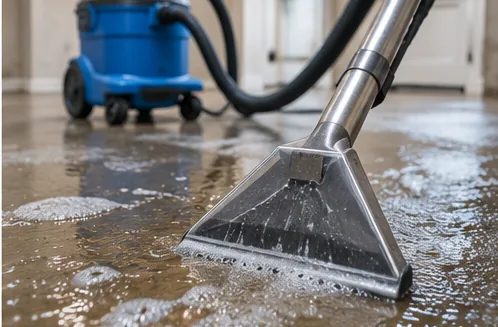
- Truck-mounted extractor. Professional equipment that combines strong suction with heat. Pulls water from carpet, padding and the water held just below the surface in porous materials. Not something a homeowner rents.
- Weighted water extractors. Professional tools that compress carpet and padding against a hard surface while vacuuming, pulling out water that a standard extractor misses.
Discharge matters too. Pumping water back into a sewer line that is already overloaded during a storm just moves the problem. Pumping it onto a neighbor's property creates a different problem. The correct discharge point depends on local rules and the storm situation.
Can You Use a Gasoline Pump to Remove Basement Water?
Only outside the basement. Gasoline engines produce carbon monoxide at levels that can be fatal in an enclosed or partly enclosed space, and CDC guidance is explicit about operating fuel-powered pumps and generators outdoors, well away from windows, doors and vents. A submersible pump in the basement with a long discharge hose and the gasoline unit outside is one way to do this correctly.
Electric submersible pumps are the usual safe option for interior use, provided power is being supplied from a dry source on a properly grounded circuit. If the basement power is compromised and you are running an extension cord from elsewhere in the house, keep the connection out of the water.
What Happens After You Remove the Standing Water?
Removing the visible water is step one of a longer process. Materials that were in contact with water keep releasing moisture for days, which is why drying is a separate scope with its own equipment and its own completion check.
The next steps, in order:
1. Moisture inspection.
Readings on walls, framing, subfloor and concrete to find where moisture is still sitting. See our moisture inspection service.
2. Selective material removal.
Materials that cannot reasonably be dried come out. Carpet padding, saturated insulation, and sections of drywall are the common ones.
3. Structural drying.
Air movers and dehumidifiers running continuously until readings meet a dry standard. See structural drying.
4. Cleaning and sanitizing.
Surface cleaning for silt and residue, with sanitizing where warranted by water category.
5. Verification.
Confirmed dry readings and documentation before any rebuilding starts. Our drying verification guide covers what good evidence looks like.
Frequently Asked Questions
What is the best way to remove 3 inches of water from a basement?
A submersible utility pump or professional extractor. A wet/dry vacuum is too small for that volume. If the water came from outside flooding and the ground outside is still saturated, remove the water in controlled stages rather than pumping fast, because fast draining can damage foundation walls.
Can a shop vac handle a flooded basement?
Only in small cases. A typical shop vac holds a few gallons to sixteen gallons. A 500 square foot basement with 3 inches of water holds about 935 gallons, so a shop vac is not sized for anything beyond a small puddle on a hard floor.
Why should you not pump a deep basement dry quickly?
Because the water inside balances pressure from saturated soil outside. Draining the interior too fast can leave exterior pressure unopposed and damage the walls or floor, a risk documented by university extension services. The right approach is gradual, staged pump-down with monitoring.
Can I use a gas-powered pump to remove basement water?
Only outside the basement. Gasoline engines produce carbon monoxide that can be fatal in enclosed spaces. CDC guidance is explicit about operating fuel-powered equipment outdoors, away from openings. For interior pumping, an electric submersible pump powered from a dry source is the usual safe option.
Does removing standing water mean the basement is dry?
No. Standing water is the visible part. Materials like drywall, insulation, carpet padding, subfloor and concrete keep holding moisture that has to be driven out with air movement and dehumidification. Confirming a basement is actually dry requires moisture readings on the affected materials.
Where does pumped basement water go?
To an approved discharge point: a drain, a dry exterior spot that does not flow back to the house or a neighbor, or a sanitary sewer connection where locally allowed. Discharging into an overloaded storm sewer during a flood event just moves the problem.