How to Verify Your Flooded Basement is Completely Dry
How Do You Know a Flooded Basement is Actually Dry?
A basement is dry when the affected materials measure to a dry standard, not when the floor looks dry. That is the simplest, most honest way to think about completion. A floor that looks dry, a room that smells fine and walls that feel cool are not evidence of a dry structure. They are evidence of what you can see, smell and touch. Hidden moisture inside walls, under flooring and in the subfloor is why basements that seem fine on day five come back as mold on day fifty.
This guide explains how professional drying is actually verified, why that matters more than a drying-day count, and what you should see in writing before anyone starts rebuilding your basement.
Why is a Dry-Looking Surface Not Proof of a Dry Basement?
Materials dry from the outside in. A drywall surface can measure within a dry range while the back side of the same sheet and the insulation behind it are still wet. A concrete slab can feel cool and dry at the top while moisture is still coming up from below. "Feels dry" is a reasonable thing to notice, but it is not what completion is judged on.
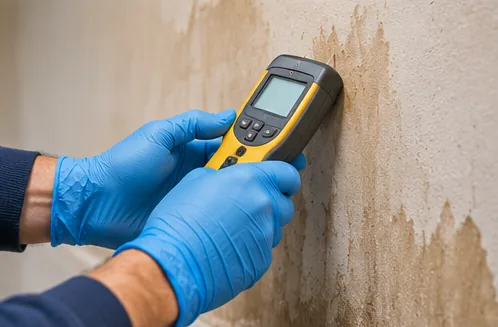
Professional drying uses moisture meters to read each affected material and compares those readings to reference readings from matching unaffected areas in the same building. When the affected material reaches the same or very close range as the reference, and holds there as conditions cycle, it is considered dry. The reference-reading approach matters, because the same number can mean dry in one material and wet in another.
Three things that should happen at completion
- A documented set of moisture readings taken over the drying period, not just at the end.
- Reference readings from unaffected areas for comparison.
- A written statement that the affected materials reached a dry standard, with the readings to back it up.
What Tools Verify Basement Drying?
| Tool | What it tells you | Important limit |
|---|---|---|
| Pin moisture meter | Moisture content at the probe location, usually inside wood or drywall | Reads at the probe only. Patterns are built from many readings, not one. |
| Pinless moisture meter | Moisture conditions at and near the surface of a material | Near-surface only. Deeper moisture can hide below the depth it reads. |
| Thermo-hygrometer | Air temperature, relative humidity and dew point in the room | Room air alone does not prove materials are dry. It only shows drying conditions. |
| Infrared camera | Surface temperature differences that often match damp areas | Shows temperature, not water. Anything flagged is confirmed with a meter. |
| Reference readings | Baseline from matching unaffected materials | Needed for comparison, because a raw number alone is not enough. |
| Concrete moisture probe | Relative humidity in a sealed hole in the slab | Takes hours to equilibrate; used for installing new flooring over concrete. |
| Calcium chloride test | Moisture vapor emission rate of concrete | Standard test for flooring installation; slow and single-point. |
What Does a Real Drying Log Look Like?
A drying log is a short daily record. It is not fancy. It is honest. A reasonable drying log shows the date, the outside conditions, the inside temperature and humidity, the readings on each affected material at identified locations, and a note on equipment moved or added. Across a job, you should be able to see the readings move toward dry over time, and you should be able to see the day the material held at dry long enough to call it complete.
If a contractor cannot produce a drying log, or produces one that looks the same every day with no readings, that is a signal. Not a crime, but a signal. Good drying work is boring to document, and the documentation is the proof.
What the log should include at minimum:
- Date and technician initials
- Outside temperature and weather
- Inside temperature and relative humidity
- Readings on each affected material at identified locations
- Reference readings from matching unaffected materials
- Equipment placement and runtime notes
- Any changes in equipment or approach
- Any conditions discovered that warrant scope change
What are the Signs a Basement is Not Really Dry?
Signs the basement likely is dry
- Moisture readings on affected materials match reference readings in matching unaffected areas.
- The readings held at that level for enough days to confirm they were not a one-day blip.
- Humidity in the room is at a normal level without the dehumidifier running.
- No musty smell, no condensation on cool surfaces, no visible damp spots.
- A written completion statement supported by the log.
Signs it probably is not
- The room still smells musty when the equipment is turned off.
- Cool surfaces are beading up with condensation.
- Readings on affected materials are still higher than the reference.
- Somebody wants to close walls or install new flooring before the readings land.
- The log is missing, incomplete or looks copied across days.
- Humidity climbs quickly when equipment goes off.
How Dry is Dry Enough for Each Basement Material?
Different materials have different dry standards. The reference-reading approach handles this because you compare each material to the same material in an unaffected area, but it helps to know roughly what to expect.
| Material | How dryness is typically evaluated | Watch-out |
|---|---|---|
| Drywall (paper-faced) | Moisture meter reading compared to unaffected reference | Back side can lag the front; check at multiple depths |
| Wood framing | Moisture content percentage, usually compared to unaffected studs | Readings vary with species and age |
| Concrete slab | Relative humidity probe or calcium chloride for installation thresholds | Surface can read dry while mass of slab is still releasing moisture |
| Subfloor | Moisture content percentage at multiple points | Water may be trapped between subfloor and finished floor above |
| Insulation | Visual plus meter where accessible; often removed if saturated | Fiberglass releases water slowly; cellulose does not recover well |
| Masonry walls | Meter compatible with masonry, compared to reference | Can hold moisture longer than apparent surface condition suggests |
What Happens if You Start Rebuilding Before the Basement is Dry?
The single biggest avoidable failure in basement flood recovery is closing new finishes over a damp structure. New drywall going on wet studs, new flooring laid over a damp slab, new paint over cool, moist walls. The homeowner sees a finished basement and goes back to normal life. Six to ten weeks later, the smell starts, or a stain shows up at the baseboard, or the paint bubbles. Inside the wall, the moisture that was supposed to be dry has now been sealed in with a food source and insulation. That becomes a mold job, which is a separate specialty and a much bigger invoice.
This is why the order matters so much. Extraction, inspection, selective removal, drying with readings, cleaning and only then reconstruction. If anyone offers to rebuild before the drying log confirms a dry standard, the right answer is to wait.
Flooring installation adds another wrinkle: many flooring products have moisture-content maximums that the substrate must meet, and installing over material above those thresholds leads to adhesion failure, warping and joint separation. Checking concrete slab moisture with a probe or calcium chloride test before installing new flooring is not optional for most products.
Frequently Asked Questions
How do I know if my basement is really dry after flooding?
By readings, not by appearance. Moisture meters on each affected material, compared to reference readings from matching unaffected materials, held at a dry standard long enough to be stable. A drying log that documents readings over the drying period is the proof.
What is a drying log?
A short daily record from the drying period. It documents date, outside and inside conditions, readings on each affected material, reference readings for comparison, equipment placement, and any changes to the approach. It is the paper proof that the structure reached a dry standard.
Can I just trust the dehumidifier reading?
No. A dehumidifier reads room air, not material moisture. Room air can be at normal humidity while the inside of a wall or the bottom of a subfloor is still wet. Material readings are the honest check.
Does an infrared camera prove a basement is dry?
No. Infrared shows surface temperature differences, not water. It is useful as a screening tool to point to areas that may be damp, but any area it flags is confirmed with a moisture meter before being treated as wet or dry.
How long should a basement run drying equipment?
Until the readings say to stop. Many projects run three to seven days of continuous equipment, sometimes longer for dense materials or cool conditions. Stopping on a schedule rather than on readings leaves moisture in materials.
What if my contractor cannot produce a drying log?
Ask for one before they finish. Good drying work produces a log almost automatically because readings are taken daily. A missing log usually means the readings were not taken, which means the completion claim does not have evidence behind it.