
Basement Flood Restoration Timeline: How Long It Really Takes
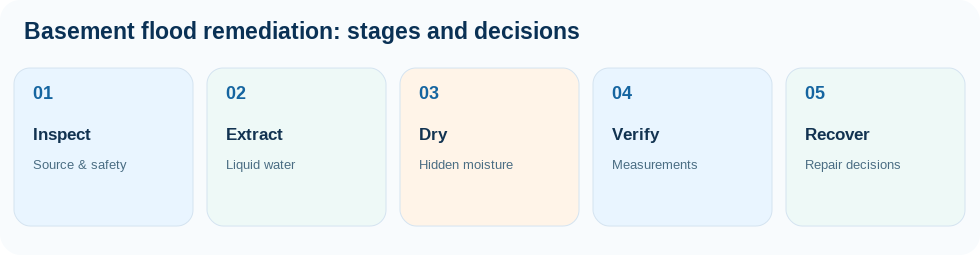
How Long Does Basement Flood Restoration Take?
Most basement flood restorations run three to seven days for the mitigation stage (extraction, inspection, removal and drying) and an additional one to several weeks for reconstruction, depending on the scope. There is no universal timeline because the duration depends on water category, affected materials, access conditions and how thoroughly the structure needs to dry. The 24 to 48 hour mold-prevention window that EPA references is about limiting mold risk, not the total restoration duration.
Timelines also depend on scope coordination. If the plumbing or sewer source needs separate repair, if drying stalls on dense materials, or if an insurance adjuster needs to inspect before reconstruction begins, each adds time. The honest version is a range.
How Long Does Each Phase of Basement Restoration Take?
| Phase | Typical range | What drives it |
|---|---|---|
| Emergency response and safety assessment | Within hours | Immediate hazards and availability |
| Water extraction | A few hours to a full day | Water volume, depth, access, contamination |
| Moisture inspection and initial mapping | Hours, usually same visit as extraction | Area size and wall/floor complexity |
| Selective material removal | Hours to one to two days | Amount of material being removed, contamination level |
| Structural drying | Three to seven days most commonly | Materials, water category, temperature and humidity |
| Cleaning and sanitization | Hours to a day, often alongside other stages | Area, surface types, contamination |
| Completion verification and documentation | Final visit, typically one hour | Readings, walkthrough, scope sign-off |
| Reconstruction | One to several weeks | Materials, finishes, permitting, trades involved |
These ranges are published-industry norms, not promises for any specific property. RestoreAdvisor's industry guidance and IICRC S500 structure both reinforce that drying duration in particular depends on materials, equipment and monitoring rather than a fixed clock.
What Determines How Long Basement Drying Takes?
Drying time is the most variable part of the process. Four variables drive it:
- Materials. Concrete and dense framing hold and release moisture slowly. Drywall dries faster. Carpet padding, if kept, can lengthen drying significantly.
- Water category. Category 3 (sewage, external flood) means more porous material removal up front, which often shortens drying because there is less wet material to dry; but it adds other time.
- Temperature and humidity. Cooler and more humid conditions slow evaporation. Winter atmospheric-river weather in California can lengthen drying noticeably.
- Equipment and monitoring. Enough air movers and dehumidifiers for the space, running continuously, and daily readings to adjust placement. Undersized equipment or interrupted runtime lengthens the job.
Our drying verification guide covers what a real drying log looks like and how completion is proven with readings rather than appearance.
What Can Delay Basement Flood Restoration?
- Hidden damage found after walls open. Scope commonly expands once drywall sections come out.
- Insurance adjuster schedule. If the adjuster needs to inspect before major demolition or before reconstruction begins, that is dependent on their availability.
- Weather. Winter storms in California can delay source repair and slow drying conditions.
- Specialist trade availability. A plumber or electrician needed before cleanup can start adds their schedule to yours.
- Permit requirements. Reconstruction that touches framing, electrical or plumbing may need a permit; inspection schedules add days.
- Contents work. Contents sorting, pack-out and specialist cleaning for belongings runs on its own schedule.
- Drying stalls. When a material does not release moisture as expected, equipment is adjusted and drying extends.
What is the Fastest and Slowest Case for Basement Restoration?
A fastest case: a small clean-water leak caught in the first hour, on unfinished concrete, in a warm dry month. Extraction in an hour, drying in two to three days, no material removal, no reconstruction. The whole thing wraps in under a week.
A slowest case: a sewage backup or major external flood in a finished basement over a long winter weekend. Significant porous material removal, specialized cleaning, drying through dense framing in cool damp conditions, insurance adjuster scheduling, and a full reconstruction scope. Mitigation in ten to fourteen days, reconstruction over four to eight weeks after that.
Most real projects land somewhere between those. The fastest thing a homeowner can do to keep the timeline tight is call quickly and get documentation started in the first few hours.
When is a Flooded Basement Safe to Use Again?
Partial use, such as walking through, is possible once standing water is removed and electrical safety is confirmed. Normal use returns after drying is verified, cleaning is complete, and any reconstruction is finished. Running equipment usually means the basement is not yet in use as living space.
Three signals that the basement is actually ready for normal use:
- Moisture readings on affected materials match reference readings in matching unaffected materials, and hold at that level.
- No musty odor with equipment off.
- Any removed materials have been replaced, and new finishes have been installed on a confirmed dry structure.
Rushing the handoff from mitigation to reconstruction is the most common avoidable cause of problems a few months later. Our drying verification guide covers how this is actually checked.
Frequently Asked Questions
How long does basement flood restoration take?
Mitigation (extraction, inspection, removal, drying) usually runs three to seven days. Reconstruction, if needed, runs one to several weeks after that. Total duration depends on water category, affected materials, access, weather and insurance coordination. There is no universal timeline.
How long does it take to dry a flooded basement?
Three to seven days is common with continuous commercial equipment. Dense materials like concrete and framing extend the time. Cool, humid conditions slow drying. Drying is complete when moisture readings meet a dry standard, not after a fixed number of days.
Is the 24 to 48 hour window the full restoration timeline?
No. EPA references that window as the point beyond which a wet structure should be treated as at risk for mold. It is a mold-prevention threshold, not a promise that restoration will complete in that time. Full restoration, including drying and reconstruction, usually takes longer.
What can delay basement flood restoration?
Hidden damage found after walls open, insurance adjuster scheduling, weather, specialist trade availability, permit requirements, contents work and drying stalls on dense materials are the usual delays. The scope can expand once concealed conditions are visible.
When can I use my basement again after flooding?
After drying is verified by moisture readings, cleaning is complete, and any reconstruction has finished. Normal use usually means equipment is no longer running. Walking through for partial use is possible earlier once electrical safety is confirmed and standing water is gone.
How long does basement reconstruction take after cleanup?
One to several weeks depending on the scope. Replacing a few drywall sections and reinstalling base trim is a few days. Rebuilding a finished basement with multiple trades, flooring and finishes can run four to eight weeks. Permit inspections add time where they apply.