Can Wet Basement Drywall, Carpet, and Belongings Be Saved?
Can Wet Basement Drywall, Carpet and Belongings Be Saved?
Some can, some cannot, and depth of water is almost irrelevant to the answer. What decides salvage is the water category, how long materials stayed wet, the material composition, and whether moisture reached the back side of the assembly. A sheet of drywall that soaked up clean water from a supply-line leak for two hours can usually be dried. The same drywall exposed to sewage for the same time usually comes out.
The material-recovery decision is one of the most important parts of a basement flood cleanup because it drives the removal cost and the reconstruction cost. Getting it right on each material saves money without creating hidden problems.
Which Basement Materials Can Be Saved After Flooding?
| Material | Clean water, quick response | Gray water or extended exposure | Sewage or long-standing |
|---|---|---|---|
| Concrete slab or wall | Clean and dry in place | Clean, sanitize, dry | Clean, disinfect, dry; test moisture |
| Drywall (paper-faced) | Often dried in place | Lower section usually removed | Removed, typically to above waterline |
| Fiberglass batt insulation | Often dried if accessible | Usually removed; dries unreliably | Removed |
| Cellulose insulation | Usually removed; does not dry well | Removed | Removed |
| Spray foam insulation | Often retained; does not absorb | Often retained; cleaned on surface | Assessed; often retained with cleaning |
| Carpet (face) | Possible with cleaning and drying | Depends on exposure; often removed | Removed |
| Carpet padding | Usually removed anyway | Removed | Removed |
| Hardwood flooring (solid) | Possible with drying; watch for cupping | Often removed if swelled | Removed |
| Engineered hardwood | Variable; glued-down less recoverable | Usually removed | Removed |
| Laminate flooring | Water-sensitive layers often fail | Removed | Removed |
| Luxury vinyl plank | Surface water-resistant; moisture trapped below is the issue | Variable; often removed if seams admitted water | Removed |
| Vinyl sheet flooring | Surface resists but moisture underneath persists | Often removed | Removed |
| Ceramic or stone tile | Clean and dry; grout may need resealing | Clean, disinfect; check substrate | Assessed; usually retained with cleaning if substrate is intact |
| Wood framing | Dry in place if structurally sound | Dry in place after cleaning | Clean, dry; assessed for retention |
| Subfloor (plywood/OSB) | Dry if accessible | Variable; may need sections removed | Often sections removed |
| Trim and baseboards | Remove to dry walls behind; often reinstall | Remove; variable salvage | Removed |
| Kitchen or bath cabinets | Dry out; check kick and back | Variable; particleboard construction often fails | Removed |
| Doors (hollow-core) | Variable; can delaminate | Often removed | Removed |
| Doors (solid wood) | Dry carefully; can warp | Dry carefully; variable | Assessed |
These are typical decisions, not absolute rules. Actual decisions use moisture meter readings, visible condition and the specific water source.
Can Flooded Basement Belongings Be Saved?
Contents divide into categories that recover differently.
- Nonporous items. Sealed metal, glass, glazed ceramic, hard plastics. Usually clean and keep, even after Category 2 water. Assess individually after Category 3.
- Furniture (solid wood). Possible to save with drying; watch for warping, finish damage and veneer failure. Upholstered pieces are harder because padding holds water.
- Furniture (particleboard, MDF). Lower recovery. These materials swell and delaminate when wet.
- Clothing and textiles. Often recoverable by washing or specialized cleaning for Category 1 and 2 water. After sewage, most goes to disposal.
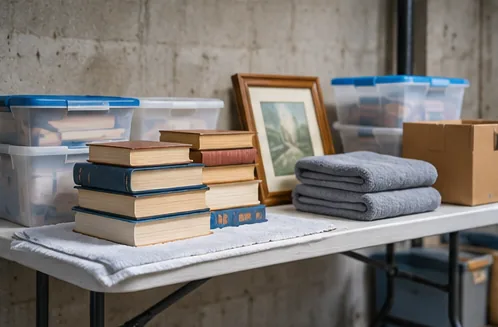
- Books, photographs, documents. Specialist contents cleaning services exist. Fastest action matters most; some can be freeze-dried or air-dried if separated quickly.
- Electronics. Powered-on wet electronics often fail. Let them dry fully and have them tested, but do not plug them in to "check."
- Appliances. Wet motors, boards and electrical components are often not economic to repair. Water heaters with submerged controls usually need replacement.
- Cardboard, paper, fabric contents. Fast absorption, limited recovery after sewage, often disposed of after any Category 3 event.
- Keepsakes and irreplaceable items. Get professional assessment before deciding to discard. Specialist contents cleaning is often worth the attempt for these.
Why are Material Recovery Decisions So Important?
These decisions matter because they drive three of the biggest cost lines in a flood recovery: removal labor and disposal, reconstruction cost, and whether hidden problems show up later.
Removing too much adds unnecessary rebuild cost. Removing too little leaves moisture or contamination sealed inside the structure, which usually becomes a mold job in a few weeks. The right decision comes from readings and from the water category, not from a rule of thumb like "cut drywall to twenty-four inches above the waterline." That heuristic is a starting point, not an actual rule, and real cuts should be where the damage ends.
EPA's flood cleanup guidance reinforces removal of materials that cannot be safely cleaned and dried, particularly after contaminated flooding. IICRC S500 covers the professional assessment of material salvage. Between the two, the material-by-material judgments above are the professional standard.
Does California Building Type Change Material Decisions?
Yes, in a few ways. California basements are often finished differently from basements in colder climates. Many homes have finished lower rooms with carpet, drywall and engineered flooring over slab. Some older homes have true below-grade basements; many newer homes have partial lower rooms or no basement at all. The material decisions follow what is actually there.
Two California-specific considerations:
- Older construction can contain lead-based paint or asbestos in some materials. If a home is old enough, demolition of certain materials requires qualified handling. Testing may be appropriate before major removal.
- Post-wildfire runoff. In some Southern California areas, floodwater can carry sediment and ash from burn scars. That changes cleaning and can push more porous materials onto the removal list.
Our material removal service walks through how the decisions are made for a specific property.
Frequently Asked Questions
Can wet basement drywall be saved?
Often, if water was clean and the drywall is accessible for drying. Lower sections usually come out after Category 2 or 3 water, and the cut goes to where the moisture actually ends rather than an arbitrary height. Paper-faced drywall soaked with sewage should be removed.
Can wet basement carpet be saved?
The carpet face often can be cleaned and dried after a Category 1 clean-water event. The padding underneath is almost always removed because it holds water against the subfloor. After Category 3 water, both the carpet and the pad are typically removed.
Does all wet insulation have to be removed from a basement?
Fiberglass batts can sometimes be dried if accessible and water was clean, but they dry unreliably and are frequently removed. Cellulose and other fibrous insulations are removed in most cases because they do not dry well. Spray foam usually stays and is cleaned on the surface.
Can laminate or luxury vinyl flooring survive a basement flood?
Laminate typically fails because its water-sensitive layers swell. Luxury vinyl plank resists surface water but can trap moisture below where seams admitted water, and is often removed when that happens. Ceramic tile with intact substrate usually survives cleaning.
Which belongings should I throw out after a basement flood?
Cardboard, paper, fabric and anything porous exposed to sewage or long-standing water are usually disposed of. Nonporous items are usually kept after cleaning. Keepsakes and electronics warrant specialist assessment before discarding; do not power on wet electronics to test them.
Is there a rule for how high above the waterline to cut drywall?
The common twenty-four inch rule of thumb is a starting point, not an actual rule. Cuts should be where the damage ends, based on moisture readings and visible condition. Cutting higher adds unnecessary rebuild cost; cutting lower leaves wet material inside the wall.