California Basement Flood Insurance: What Actually Gets Covered
Does California Homeowners Insurance Cover a Flooded Basement?
It depends on the water source and the specific policy. There is no single rule that says "homeowners insurance covers a flooded basement" or "it never does." This guide walks through what is usually covered, what is usually not, where the National Flood Insurance Program fits, and what California's Department of Insurance says that you can verify yourself.
Nothing on this page is a legal or insurance opinion. We do not sell insurance or promise an outcome. We write this because homeowners deserve to know what questions to ask before they file.
Which Basement Flood Causes are Covered by Insurance?
| Water source | Usually covered under | Common exclusion or gotcha |
|---|---|---|
| Sudden, accidental interior pipe burst | Homeowners policy (often) | Gradual or long-term leaks may be excluded; mold caps can apply. |
| Water heater or appliance line failure | Homeowners policy (often) | Age, maintenance and pre-existing leaks can affect the claim. |
| External surface flooding (rain, runoff, river) | Separate flood insurance (often NFIP) | Standard homeowners usually excludes external flood. |
| Sewer or drain backup through floor drain | Water-backup endorsement | Not always included in a base homeowners policy. Separate add-on. |
| Sump pump failure or overflow | Sump overflow endorsement | Depends on cause (power outage vs mechanical) and policy terms. |
| Groundwater seepage or recurring entry | Often excluded | Long-term seepage is commonly treated as maintenance, not a loss. |
| Mudflow or debris flow (post-wildfire runoff) | May fall under flood policy or disaster programs | Depends on event and policy; document everything. |
This is a general map, not a policy reading. California's Department of Insurance publishes official flood insurance guidance you can review before filing. Your own policy is the final word.
How Does Flood Insurance Treat a Basement?
The National Flood Insurance Program carries specific limitations on basements, and they catch a lot of homeowners by surprise. In general, NFIP distinguishes between the basement structure and what is in it. Certain installed equipment such as a furnace, water heater, sump pump and some permanent utilities may be covered under the building portion. Finished basement improvements, personal belongings stored in the basement, carpet installed over concrete, and many common items are commonly excluded or sharply limited.
That matters because a finished basement that cost thousands of dollars to build out can be in a home with a flood policy that still does not cover the finishes. A policyholder who understands this before a loss can plan differently. One who finds out afterward usually finds it painful.
Questions to ask your insurer
- Which coverage applies to this water source?
- Is there a sewer-backup or sump-overflow endorsement on my policy, and what is its limit?
- Does my flood policy cover finished basement improvements and belongings? What is the basement exclusion?
- What proof-of-loss documentation do you require?
- How does my deductible apply to this type of loss?
- What is the claims deadline for reporting?
- Do you require specific documentation during cleanup to preserve the claim?
What Documentation Do You Need for a Basement Flood Insurance Claim?
The number-one reason basement claims get reduced or denied is not fraud. It is thin documentation. Adjusters cannot pay for what they cannot see, and photos taken at the end of cleanup are much less useful than photos taken at the start. If you can safely take pictures and notes before anything is moved, do.
- Photos of the water in place, the source area if identified, and the affected belongings before they are moved.
- A description of when the water first appeared and when it stopped coming in.
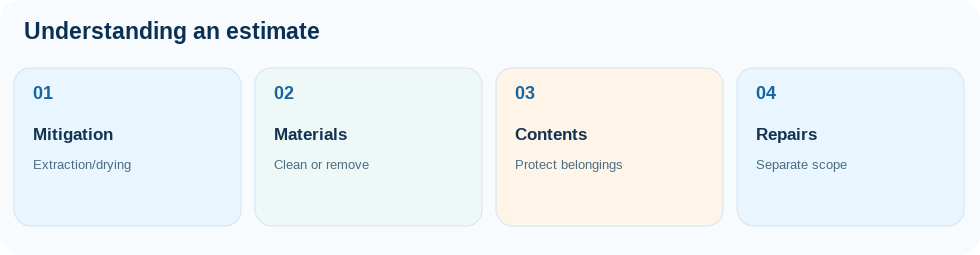
- The contractor's scope of work, in writing, with extraction, drying, cleaning, removal and reconstruction as separate line items.
- Moisture readings and the drying log that show the basement actually reached a dry standard.
- Any disposal records for contaminated materials, if sewage was involved.
- A clear separation between what is remediation (restoring the structure) and what is reconstruction (rebuilding what was removed).
- Receipts for emergency measures, equipment rental, and any out-of-pocket mitigation.
- Communications from plumbers, electricians or other trades involved in stopping the source.
How Does This Play Out by Water Source in California?
Winter storm flooding, Bay Area
If water came through the foundation or a window well during a wet-season storm, external flood is the usual framing. Without a flood policy, a standard homeowners policy often will not pay for the cleanup. With NFIP, the structural work may be covered, but finished basement improvements and personal belongings often will not be.
Supply line burst, any county
A pipe that broke suddenly and sent water into a finished basement is often covered under a homeowners policy, subject to the deductible and policy terms. Gradual leaks that went on for weeks are a different situation and commonly excluded.
Sewer backup, San Francisco or older urban area
Combined sewer areas can see backups during intense rain. Coverage usually depends on a sewer or water-backup endorsement, which is an add-on, not a given. Check for it before you need it.
Sump pump overflow after a power outage
Sump pump failure and overflow are often covered only with a specific endorsement. Whether it applies can depend on the cause of the failure. A battery backup may change coverage in some policies.
Groundwater seepage, Sacramento older home
Recurring seepage is commonly treated as a maintenance issue rather than an insured loss, especially where the pattern is known. The remediation is still real work, but the insurance path is usually narrower.
Post-fire debris flow, Southern California
In areas affected by recent wildfires, rain-driven debris flows may fall under flood policy or be handled through emergency disaster programs. The specifics depend on the event and the property. The California Department of Insurance has issued flood-coverage advisories ahead of wet-season storms in these areas.
What if the Insurance Settlement is Less Than the Mitigation Invoice?
This happens. Scope disagreements usually come down to which equipment was justified, how many days of drying were needed, which materials were correctly removed, and whether reconstruction scope was reasonable. The strongest response is a detailed drying log with moisture readings, itemized line items for each stage, and photographs through the project.
Specific angles that help in a disagreement:
- Equipment count matched to affected square footage and material load (not just rented for days).
- Drying log showing readings justified continued runtime of each piece of equipment.
- Material removal justified by moisture readings or water category (not a reflex cut).
- Reconstruction scope matches what was removed, not an upgrade in scope.
- Documentation of any scope change before it happened, with reason and approval.
You have the right to appeal a reduced settlement and to ask your insurer to explain which items they reduced and why. California's Department of Insurance publishes guidance on consumer rights in claims handling.
Frequently Asked Questions
Does California homeowners insurance cover a flooded basement?
It depends on the water source. A sudden, accidental interior leak may be covered. External flooding, groundwater seepage and sewer backups are commonly excluded from a base homeowners policy and may require separate flood insurance or specific endorsements. The California Department of Insurance publishes guidance you can review before filing.
Does NFIP flood insurance cover finished basement damage?
NFIP carries specific basement limitations. Certain installed equipment may be covered under the building portion of the policy, while finished improvements, personal belongings and some installed items are commonly excluded or sharply limited. Read the basement provisions of your policy or ask your insurer directly.
Will a sewer backup be covered by my homeowners policy?
Usually only if you have a sewer-backup or water-backup endorsement. It is an optional add-on in many policies rather than standard coverage. Check the endorsements listed on your declarations page.
Does a sump pump failure count as flood insurance or homeowners?
It depends on the cause and your endorsements. Sump overflow is often addressed through a specific endorsement to a homeowners policy rather than a flood policy. Coverage can depend on whether the failure was mechanical, power-related or capacity-related.
Can the restoration company promise what my insurer will pay?
No, and nobody who promises that should be trusted. The coverage decision is between you and your insurer. A good restoration provider gives you the documentation, scope and drying records your insurer needs to see, but the payment decision is theirs.
What if my insurer offers less than my mitigation invoice?
This happens. Scope disagreements usually come down to which equipment and how many days of drying were justified. A detailed drying log, moisture readings and line-item scope is the strongest response. You also have the right to appeal and to ask your insurer to explain which items they reduced and why.
How quickly do I need to report a basement flood to my insurer?
As soon as practical, usually the same day or the next business day. Many policies require prompt notification, and delays can complicate the claim. If immediate mitigation is underway, you can call during the mitigation; you do not have to wait for the cleanup to finish.